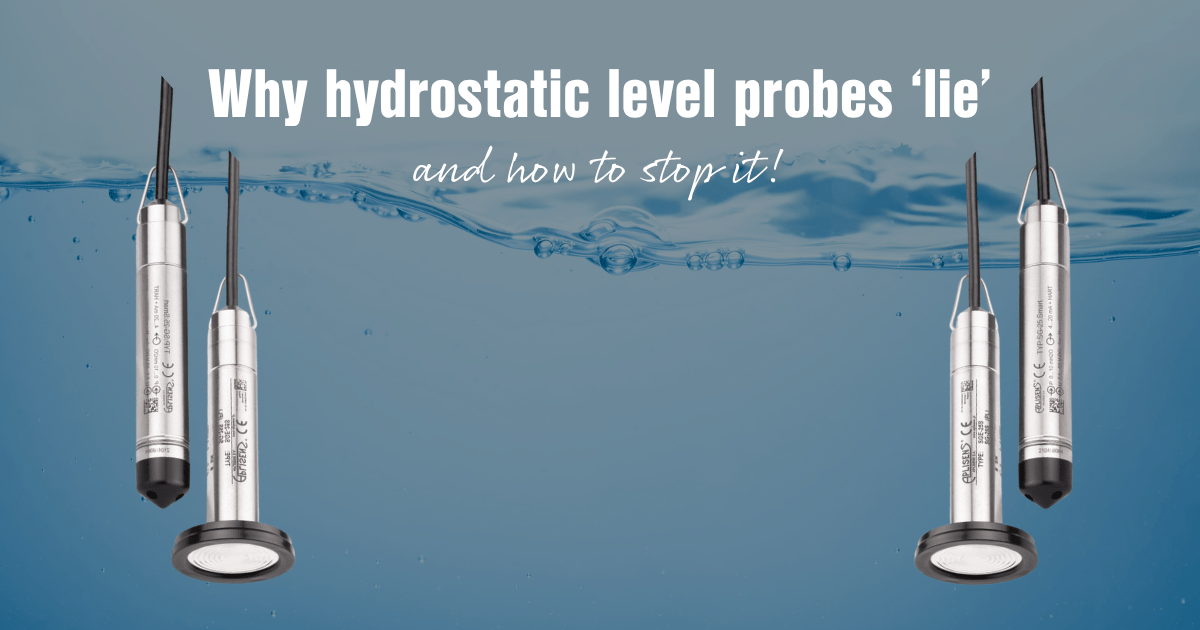
Why hydrostatic level probes lie and how to stop it
2026-05-21
When a level reading starts jumping around, drifting, or triggering alarms for no obvious reason, the probe often gets blamed first. However, in most cases, the issue lies with installation conditions, process effects, or incorrect assumptions. Resulting in poor level measurement.
By understanding how hydrostatic level probes work and what can affect them, you can avoid many of the most common problems before they happen. If you need to know more about how hydrostatic level probes work, read our article "What is hydrostatic level monitoring?".
In this article, our application experts explain why hydrostatic level probes appear to lie, the most common failures, and how OEM, working with Aplisens, can help engineers prevent them.
Learning hub
1. Problems with the atmospheric reference
The problem:
Many hydrostatic level probes use a capillary or vent tube inside the cable to reference atmospheric pressure. If that vent path is blocked, contaminated, or terminated incorrectly, the probe can show offset, drift or unstable readings even if the sensing element itself is still functioning correctly.
Why it happens:
- Sealing the cable termination in a way that prevents atmospheric equalisation
- Moisture and contamination in the vent path
- Condensation forming inside the capillary
- Temperature changes causing trapped air or oil vapour
Typical issues include:
- a zero offset
- slow or wandering readings
- seasonal or weather-related drift
- level values that do not match what operators see on site
Solution
OEM works with customers at the application and installation stage, not just device selection.
- Non‑hermetically sealed termination so internal pressure can equalise with atmosphere.
- Correct cable routing and termination protection prevents moisture and contamination issues.
- The atmospheric reference in Aplisens probes is maintained via a capillary integrated into the cable.
Resulting in stable zero, faster response, and long‑term reliability, without changing the probe.
2. Turbulence, aeration and poor probe placement
The problem
Hydrostatic probes measure pressure at a point. In calm liquid, that pressure is a good representation of level. However, in turbulent conditions, the pressure at the measuring point can fluctuate rapidly, even when the liquid level has not changed.
Why it happens:
Fast‑moving liquid creates dynamic pressure components that the probe cannot distinguish from static head pressure.
Typical issues include:
- Noisy level signals
- Rapid oscillation
- False high or low alarms
- Unstable pump control behaviour
This is common in pump stations, inlet zones, agitated tanks and applications with high inflow velocity. In these cases, signal damping can help, but it should not be used to hide a poor installation. Mechanical measures such as sensible probe placement and a stilling or screening tube are usually the better first step.
Solution
Rather than filtering the signal until it becomes unusable, the correct solution is mechanical stability.
- Sensible probe placement
- Stilling or screening tube
- Signal dampening


3. Density changes in the process
The problem:
Hydrostatic level measurement relies on the relationship: Pressure = liquid density × gravity × liquid height
If liquid density changes, the same pressure no longer represents the same level.
Why it happens:
- Temperature changes significantly
- The liquid contains high solids
- Concentration varies during the process
- The medium is not clean water
Typical issues include:
- Incorrect level measurements
- False high or low readings
Solution
The conversion from pressure to level needs to reflect the real process conditions. Damping may smooth a fluctuating signal, but it does not correct density-related error. In these applications, it is important to select the correct range, materials and configuration.
- Understand whether density variation is significant in the application
- Select appropriate ranges and outputs
- Apply configuration, damping, or correction where needed



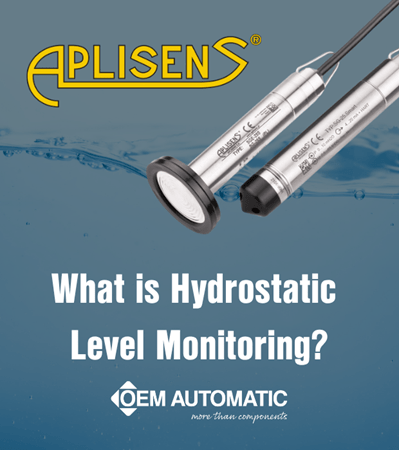
Choosing the Right Probe for Water & Wastewater
At OEM Automatic we supply and support water and waste water applications with Aplisens hydrostatic probes:
- Measurement ranges from 1 to 500 mH₂O
- Integrated internal overvoltage protection
- Options for DNV marine approval and ATEX intrinsic safety
- Versions designed for liquids with contaminants or suspended solids, using large, uncovered diaphragms to reduce sediment effects
- Smart variants add 4–20 mA plus HART communication, with configurable range, zero shift and damping
Each product is carefully selected to meet the diverse requirements of water applications.
For applications requiring:
- Digital commissioning
- Remote diagnostics
- Adjustable damping or zero
Need Help with a level measuring?
Our Pressure & Flow Team is here to help! Whether you need expert advice, product recommendations, or a proof-of-concept demonstration:
 Phone support – Call us at 0116 284 9900
 Email support – Contact us at [email protected]
 Live chat – Available on our website
 On-site visits – Our expert sales engineers can provide in-person demos and application support. Email [email protected] to arrange a visit or call us.
Let us help you with your level measuring application. Contact us today!
related products
Aplisens - SGE-25 Smart Level Sensor
Hydrostatic
- 1..100mH2O
- 4-20mA & HART protocol
- ATEX option
- Marine certification (DNV) option

Aplisens - SGE-25 Level Sensor
Hydrostatic
- 1..500mH2O range
- 4-20mA
- ATEX option
- Marine certification (DNV) option