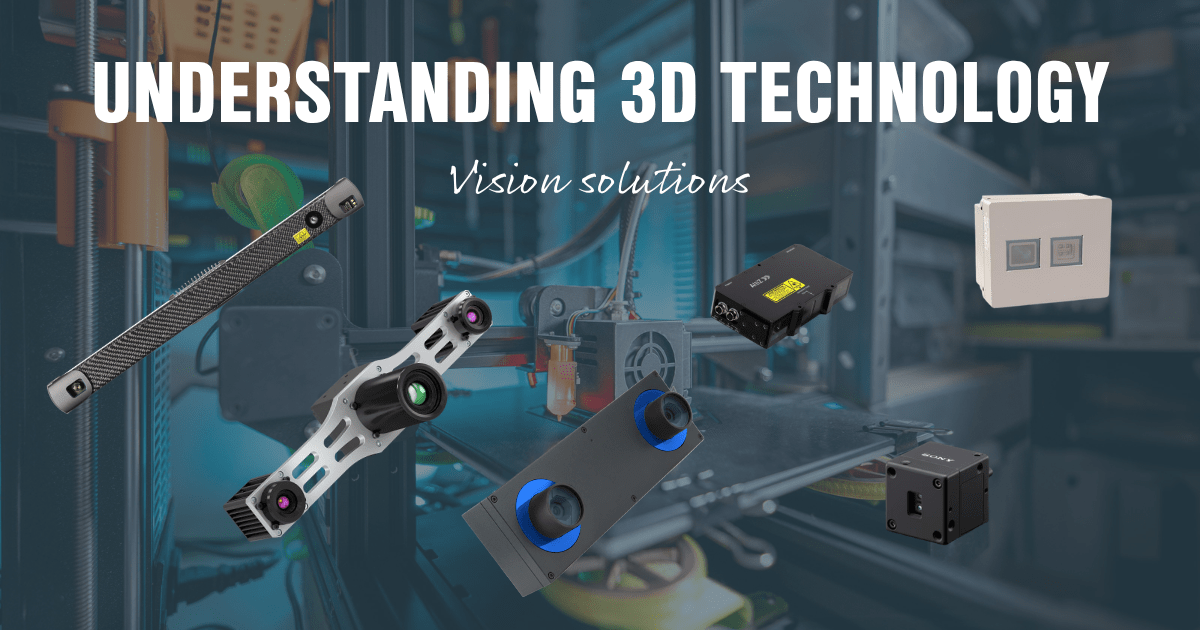
Understanding 3D Vision Technologies: Choosing the Right Solution for Your Application
2026-07-27
3D vision technology is transforming automation across industries, enabling more accurate detection, measurement, and interaction with real-world environments. But with several different technologies available, choosing the right solution can be challenging.
Our Machine & Computer Vision specialists outline the key 3D vision technologies, how they work, and where they are best suited.
Learning hub3D Vision Applications:
3D systems are widely used in industrial automation and robotics, supporting applications such as:
- Bin picking and pick-and-place operations
- Palletising and depalletising
- Packaging and assembly
- 3D modelling and reverse engineering
- Trajectory correction and robot guidance
- SLAM (Simultaneous Localisation and Mapping), including drone navigation
These applications rely on accurate depth information to improve precision, efficiency, and reliability.

3D Vision Technologies
1. Parallel Structured Light
This technology projects a defined light pattern onto an object and uses a camera to analyse distortions in that pattern to calculate depth.
Best suited for:
- High-quality 3D scanning
- Capturing detailed surfaces and shapes
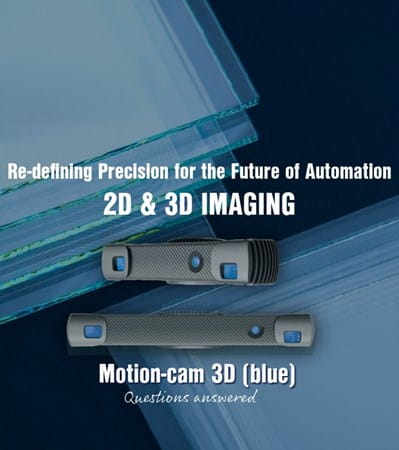
Key advantage: Strong performance on challenging surfaces, including transparent or reflective materials (as demonstrated by advanced motion-based systems)

2. Stereo Vision
Stereo vision uses two cameras to capture images from different angles, calculating depth via triangulation.
Best suited for:
- General-purpose 3D imaging
- Robotic guidance and inspection
Key advantage: Cost-effective and versatile
However, performance can be lower in scenes with little visual texture

3. Laser Profiling
Laser profilers use a laser line projected onto an object, with cameras capturing the deformation of that line to build precise 3D profiles.
Best suited for:
- High-precision measurement tasks
- Detailed surface profiling
Key advantage: Very high accuracy, capable of producing dense 3D data such as profiles, depth maps, or point clouds

4. Time-of-Flight (ToF)
Time-of-Flight sensors measure the time it takes for emitted light (typically infrared) to reflect back from an object, calculating distance based on this timing.
Best suited for:
- Fast, real-time 3D sensing
- Larger working distances and dynamic environments
Key advantage: Robust and efficient for industrial applications
However, it has lower fine-detail resolution compared to other technologies

Matching Technology to Application
Each 3D technology brings different strengths:
- Structured Light - Ideal for high-quality scans and challenging materials
- Stereo Vision - Flexible and cost-effective for general automation
- Laser Profiling - Best for high-precision inspection and measurement
- Time-of-Flight - Suited to fast, robust sensing over larger areas
In practice, the right choice depends on factors such as accuracy requirements, working distance, object type, and environmental conditions.
Supporting a Range of Industrial Needs
OEM Automatic offers a portfolio of 3D vision solutions from leading manufacturers, covering:
- High-resolution scanning for demanding inspection tasks
- Flexible stereo systems for automation and robotics
- Robust ToF sensors for industrial environments
- Compact depth sensors for mobile and embedded systems
As the official distribution partner for Sony, Basler, and Zebra in the UK and Ireland, OEM Automatic can support a wide range of 3D applications.
You can also find more information on 3D technology in our short brochure, created by our Vision Expert Ibrahim.
Need Help with a 3D Application?
Our Machine Vision Team is here to help! Whether you need expert advice, product recommendations, or a proof-of-concept demonstration:
 Phone support – Call us at 0116 284 9900
 Email support – Contact us at [email protected]
 Live chat – Available on our website
 On-site visits – Our expert sales engineers can provide in-person demos and application support. Email [email protected] to arrange a visit or call us.
Let us help you find the right 3D product for your application. Contact us today!